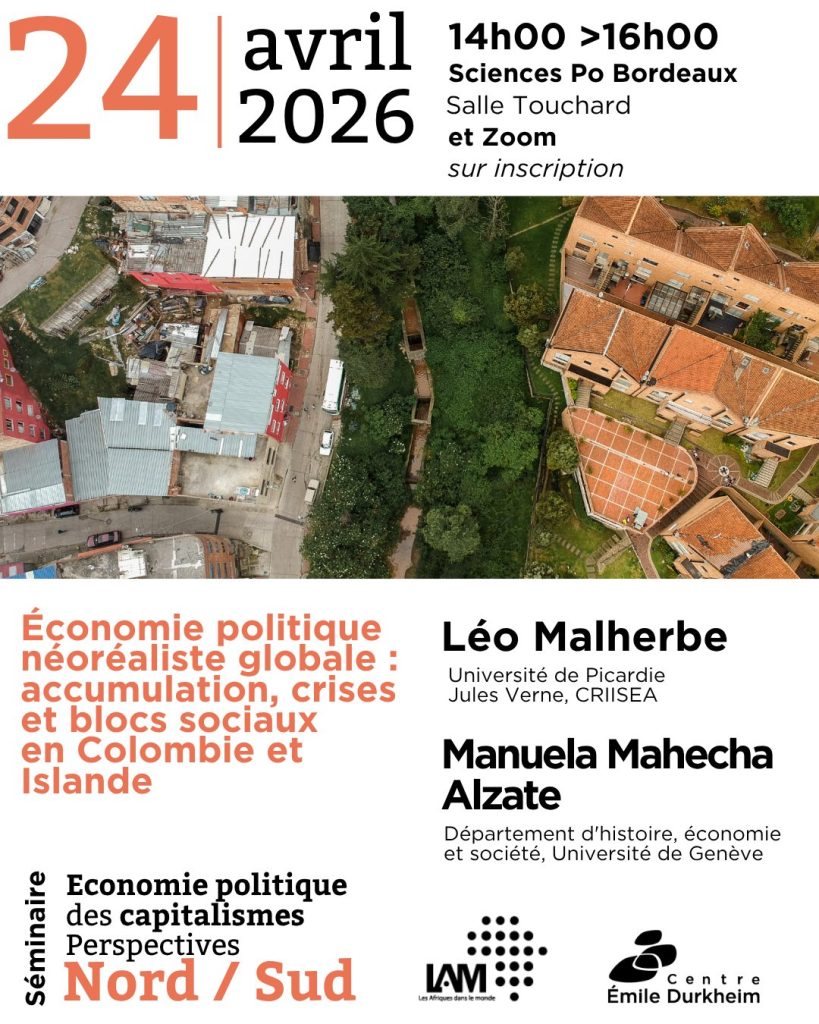
Cette séance porte sur l'actualité de la recherche en économie politique néoréaliste et met en avant le caractère de plus en plus global de l’approche, qui est désormais mobilisée pour analyse des pays du Nord et du Sud. Elle explorera les imbrications entre accumulation et contestation ainsi que la formation de blocs sociaux dans les cas islandais et colombien. Outre les affinités théoriques entre les deux présentations, la séance permettra également de mettre en dialogue les caractéristiques communes des économies étudiées, comme le rôle clé des industries exportatrices fondées sur l’exploitation de ressources naturelles (accumulation extractive extrovertie), tout en montrant la politisation différentielle de ces communalités.
Léo Malherbe, maître de conférences à l’Université de Picardie Jules Verne, CRIISEA
Voting Determinants and Electoral Behavior in Iceland The Impact of the 2008 Financial Crisis
Résumé de la présentation : This presentation examines the structural determinants of voting behavior within the framework of Iceland’s traditional four-party political landscape, with a specific focus on the transformative effects of the 2008 financial crisis. Using data from the Icelandic National Election Studies (ICENES), we analyze individual socio-economic characteristics and preferences regarding public policies, particularly economic policy, that influence voting patterns. Our study combines an exploration of long-term voting trends with an analysis of how the crisis affected the size and composition of party electorates. Through logistic regression analysis, we identify key predictors of electoral behavior and document significant changes in Iceland’s political landscape after the crisis. This research contributes to a deeper understanding of the interplay between economic crises and electoral behavior, shedding light on how such crises can reshape political cleavages and voter allegiances.
Manuela Mahecha Alzate, docteure en sciences de la société mention political economy, Département d'histoire, économie et société, Université de Genève
Between repression and clientelism : Colombia’s Dominant Social Bloc, 2002-2019
Résumé de la presentation : This intervention examines the power dynamics shaping Colombia's economy since the 2000s, a period marked by growth concentrated in the extraction of energy commodities and the financial sector. We resort to the concept of the Dominant Social Bloc (DSB), derived from Bruno Amable and Stefano Palombarini's neorealist approach to institutional change. The DSB is defined as a coalition of dominant social groups benefiting from institutions and public policies in exchange for providing political support. This study identifies the composition of the DSB in Colombia since the 2000s by analyzing how the social groups favored by the country's growth pattern have provided political support. In adapting the neorealist framework to a peripheral economy, it incorporates key dimensions such as economic dependence, subordinate integration into the global economy, as well as country-specific factors including drug trafficking and armed conflict. The findings reveal a DSB in Colombia composed of domestic and international capital, business associations, large landowners, actors linked to drug trafficking and paramilitarism, and beneficiaries of public subsidies. Together, these results show that Colombia’s political economy is structured through the articulation of economic dependence, coercion, and clientelistic arrangements.
Autres événements à venir

Capitalisme mature et vieillissement : un programme de recherche
Matthieu Montalban, professeur des universités d'économie à Sciences Po Bordeaux et chercheur au laboratoire Les Afriques dans le Monde


Le sensible en partage : enjeux de la production et de la reconnaissance des savoirs
Agnès Villechaise et Jessica Brandler

La ville verte au pied du mur
coorganisé avec le Forum Urbain Avec Félix Adisson et Ludovic Halbert